

⚠️Important Legal Notice: All content within this article is for educational and informational purposes only. Please be aware that in many jurisdictions, the unauthorized use of equipment designed to jam radio communications (including anti-drone jammers) is strictly illegal and can lead to severe legal penalties. This information does not constitute legal advice. Users bear the sole responsibility for ensuring all actions and technological applications strictly comply with all applicable laws and regulations in their region.
Drone detector vs drone jammer is a common comparison for buyers who are planning an anti-drone system. As commercial drones become easier to buy and operate, low-altitude security has become a growing concern for airports, prisons, oil depots, power stations, border areas, public events, and critical infrastructure sites.
When buyers start looking for anti-drone equipment, they often ask one common question:
“Do I need a drone detector or a drone jammer? “
The answer is usually not “one or the other.” A drone detector and a drone jammer play different roles in an anti-drone system. A detector helps users discover, identify, and track drone threats. A jammer is used for active countermeasure after the threat has been confirmed and the response is authorized.
In a complete anti-drone system, detection and jamming should work together. Detection provides the early warning and decision-making information. Jamming provides the active response capability. In more advanced systems, detection, jamming, and even spoofing can be integrated into one complete anti-drone solution.
This article explains the difference between drone detectors and drone jammers, how they work together, and why integrated anti-drone systems are becoming an important trend in low-altitude security.
Why Drone Detection and Jamming Work Better Together
A drone threat response should not begin directly with jamming. In a professional anti-drone workflow, users first need to know whether there is a drone, where it is, what type of signal it uses, and whether it is a real threat.
That is why detection comes first.
A drone detector acts like the “eyes and ears” of the anti-drone system. It helps security personnel detect nearby drones, identify signal characteristics, track movement, and understand the possible risk before taking action.
A drone jammer, on the other hand, is the active countermeasure tool. It is used after detection and risk judgment. Its purpose is to interfere with unauthorized drone communication, video transmission, or navigation signals within the lawful and authorized scope.
In simple terms:
- Drone detector: finds and identifies the drone.
- Drone jammer: performs active countermeasure.
- Integrated anti-drone system: combines detection, identification, jamming, and sometimes spoofing into one coordinated solution.
For temporary patrol missions, a separate drone detector and portable jammer may be enough. For airports, prisons, oil depots, power stations, and other high-value areas, an integrated anti-drone system is usually more suitable because it can provide faster response, easier operation, and better system-level coordination.
Drone Detector vs Drone Jammer: Key Differences
The phrase drone detector vs drone jammer does not mean that the two devices are enemies or substitutes. It means buyers need to understand their different roles before building an anti-drone solution.
| Item | Drone Detector | Drone Jammer |
|---|---|---|
| Main Role | Detect, identify, locate, and track drones | Interfere with unauthorized drone signals |
| Working Stage | Before countermeasure | During countermeasure |
| Main Output | Warning, drone information, location, trajectory, risk awareness | Signal disruption or controlled countermeasure response |
| Typical Use | Early warning and surveillance | Active defense after confirmation |
| Main Limitation | Cannot stop drones alone | Requires detection, confirmation, and lawful authorization |
| Best Application | Works with jammer or integrated system | Works after detection and risk judgment |
A detector is valuable because it gives users time to react. It helps security personnel understand what is happening in the protected airspace before taking further action.
A jammer is valuable because it provides an active countermeasure capability. However, jamming effectiveness is influenced by frequency, power, antenna design, distance, and environment. For a deeper explanation of jamming distance and influencing factors, you can read How Far Can a Signal Jammer Work?.
For many security projects, the most reliable approach is not to choose only one device, but to build a workflow where detection and countermeasure are connected.
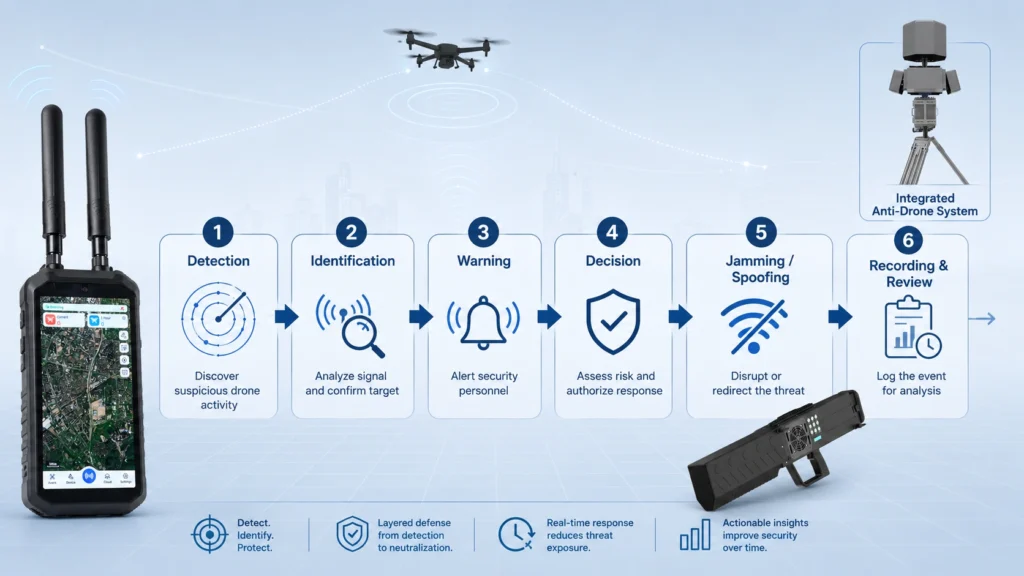
For example, a portable drone detector such as Hummingbird-DET-2 can help security personnel discover and identify drone activity, while a portable countermeasure device such as Lance-CM can provide active response capability after the threat is confirmed.
How They Work Together in an Anti-Drone System
The drone detector vs drone jammer workflow is not about placing a jammer on site and waiting for a drone to appear. A professional anti-drone system is a complete process from threat discovery to response.
A typical workflow may include:
- Detection
The drone detector monitors the low-altitude airspace and discovers suspicious drone activity. - Identification
The system analyzes drone-related signals or flight information to help confirm the target and reduce false alarms. - Warning
Security personnel receive an alert and review the drone position, route, or threat level. - Decision
The operator or system decides whether countermeasure action is required based on the situation and legal authorization. - Jamming or Spoofing
If action is authorized, the jammer or integrated system performs the countermeasure. In some systems, spoofing may also be used as part of the response strategy. - Recording and Review
The event can be recorded for later analysis, maintenance, or security reporting.
This workflow is important because anti-drone defense is not only about signal power. It is about knowing what is happening, choosing the correct response, and reducing unnecessary interference.
For small patrol tasks, the workflow may be handled manually by security personnel using a portable detector and a portable jammer. For high-security locations, the workflow is often integrated into one system with automatic detection, warning, and countermeasure strategy.
This is where integrated anti-drone equipment becomes more valuable.
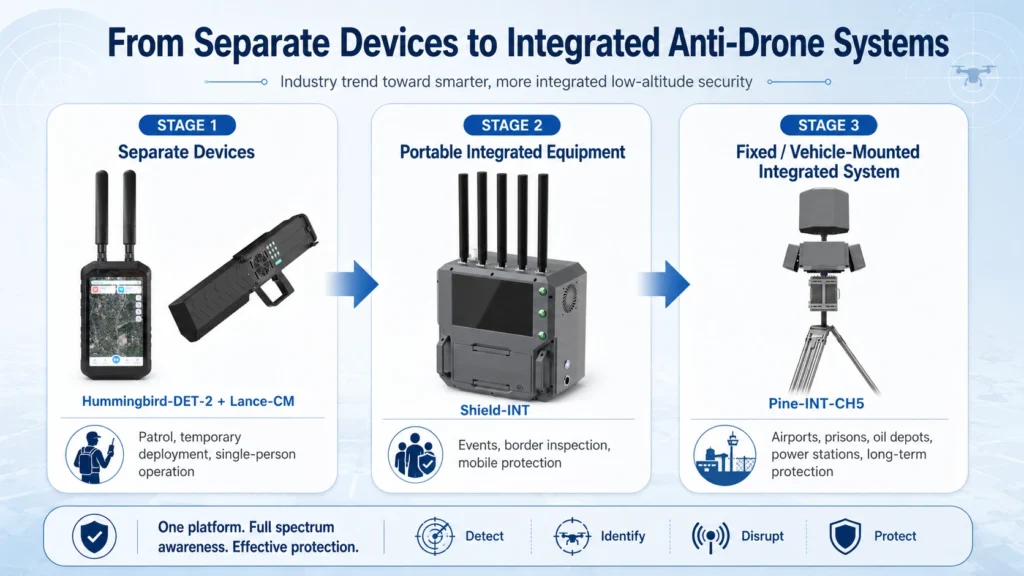
From Separate Devices to Integrated Anti-Drone Systems
Anti-drone technology is moving from separate devices toward integrated systems.
In earlier or smaller deployments, users may combine a standalone drone detector with a standalone drone jammer. This approach can be flexible and cost-effective. For example, a team may use Hummingbird-DET-2 for detection and Lance-CM for portable countermeasure during patrol, temporary event security, or emergency response.
However, as low-altitude security requirements become more complex, many buyers need more than separate devices. They need faster coordination, easier operation, and better integration of detection, jamming, and spoofing functions.
This is why integrated anti-drone systems are becoming more important.
Portable Integrated Equipment: Shield-INT
The Shield-INT integrated detection and jamming system represents a portable integrated approach. It is designed for portable use, equipped with directional antennas, and can support detection and jamming integration by installing a detection module.
Compared with a separate detector and jammer combination, Shield-INT is more suitable for users who need a compact system that can be quickly deployed in the field. It is designed for scenarios such as important conferences, cultural and sports activities, border inspections, and other temporary or mobile low-altitude protection tasks.
Shield-INT also reflects an important industry direction: portable anti-drone equipment is no longer limited to simple jamming. Detection, jamming, and spoofing can be combined to improve response efficiency and reduce the burden on frontline personnel.
Fixed or Vehicle-Mounted Integrated System: Pine-INT-CH5
The Pine-INT-CH5 integrated anti-drone system represents a more complete integrated system direction. It is composed of detectors and a four-sided directional jamming array. It can detect, identify, jam, and counter drones, and it supports fixed or vehicle-mounted deployment.
This type of system is suitable for locations that require wider-area, longer-term, or unattended low-altitude protection. Examples include airports, prisons, oil depots, power stations, border areas, and other critical infrastructure sites.
Pine-INT-CH5 also supports automatic detection and defense strategy configuration, making it more suitable for users who need continuous protection instead of temporary manual response.
The difference between separate devices and integrated systems can be summarized simply:
| Solution Type | Example | Suitable Scenario |
|---|---|---|
| Separate detector + jammer | Hummingbird-DET-2 + Lance-CM | Patrol, temporary deployment, single-person operation |
| Portable integrated equipment | Shield-INT | Events, border inspection, mobile protection |
| Fixed or vehicle-mounted integrated system | Pine-INT-CH5 | Airports, prisons, oil depots, power stations, long-term protection |
For many future anti-drone projects, integrated systems will become the preferred direction because they combine awareness, decision support, and countermeasure capability into one complete solution.
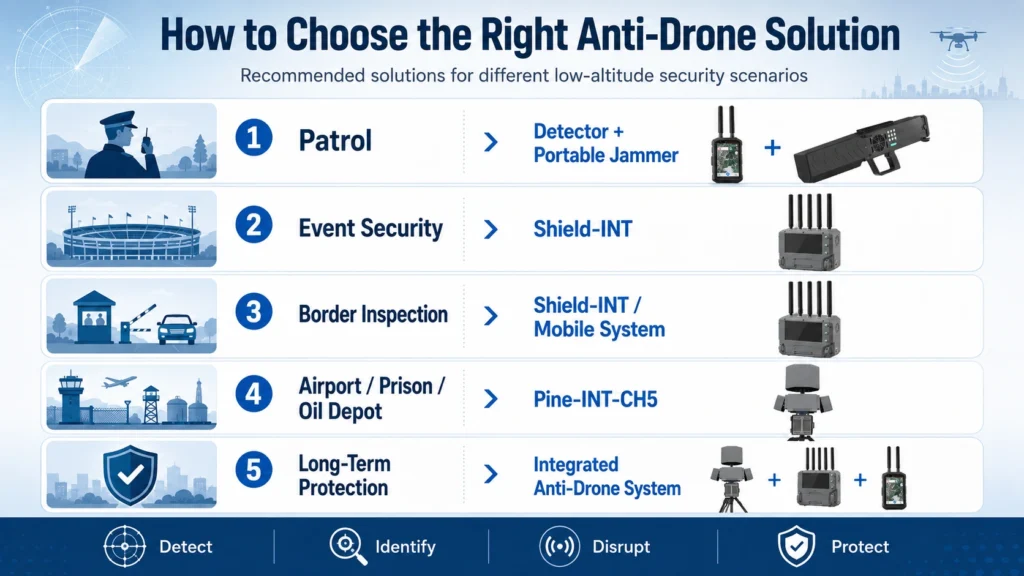
How to Choose the Right Anti-Drone Solution
Choosing the right anti-drone solution depends on the protected area, threat level, deployment method, response requirement, and budget. For critical infrastructure and public gathering scenarios, CISA’s Be Air Aware resources also provide useful background on drone-related security risks and risk awareness.
For single-person patrol or temporary low-altitude protection, a portable detector and portable jammer may be practical. This combination is flexible and easy to deploy. It is suitable for users who need mobility and manual response.
For temporary events, border inspection, or mobile security tasks, an integrated portable system such as Shield-INT may be more suitable. It reduces the complexity of using multiple separate devices and provides a more complete field-deployable solution.
For airports, prisons, oil depots, power stations, industrial parks, or other high-value locations, a fixed or vehicle-mounted integrated system such as Pine-INT-CH5 is usually a better choice. These scenarios often require continuous monitoring, faster warning, multi-band countermeasure capability, and long-term system reliability.
| Scenario | Recommended Solution |
|---|---|
| Single-person patrol | Portable detector + portable jammer |
| Temporary event security | Shield-INT or portable integrated equipment |
| Border inspection | Shield-INT or mobile integrated system |
| Airport, prison, oil depot, power station | Pine-INT-CH5 or fixed integrated anti-drone system |
| Long-term unattended protection | Integrated system with detection, jamming, and automated response |
Before choosing a solution, buyers should consider:
- Do you need early warning before countermeasure?
- Do you need active jamming capability?
- Do you need spoofing function?
- Is the deployment temporary, portable, fixed, or vehicle-mounted?
- Is 24/7 unattended operation required?
- What drone frequency bands need to be monitored or countered?
- Does the system need to connect with a software platform?
- Is customization required for frequency bands, power, antennas, or installation method?
A drone detector and a drone jammer are not two competing choices. They are two different parts of a complete anti-drone defense workflow. The detector helps users discover and understand the threat. The jammer provides the active response capability. Integrated systems combine these functions into a more efficient and scalable solution.
As a source manufacturer of anti-drone equipment and RF modules, Zorelock can support both separate device deployment and integrated anti-drone system customization. Whether you need a portable detector, a drone jammer gun, a portable integrated device, or a fixed anti-drone system, Zorelock can help match the right product configuration to your security scenario.
The future of low-altitude defense is not only about stronger jamming power. It is about smarter detection, faster decision-making, coordinated countermeasure, and integrated system design.