

⚠️Important Legal Notice: All content within this article is for educational and informational purposes only. Please be aware that in many jurisdictions, the unauthorized use of equipment designed to jam radio communications (including anti-drone jammers) is strictly illegal and can lead to severe legal penalties. This information does not constitute legal advice. Users bear the sole responsibility for ensuring all actions and technological applications strictly comply with all applicable laws and regulations in their region.
Drone smuggling has become a serious perimeter security challenge for prisons and correctional facilities. In the past, prison security mainly focused on walls, gates, visitor checks, vehicle inspection, patrol routes, and internal monitoring. Today, low-altitude airspace has become another layer of risk. A small drone can approach a facility from above, cross traditional physical barriers, and attempt to deliver contraband into yards, roofs, windows, or other exposed areas.
For correctional institutions, this is not only a technology issue. It is an operational security issue. Drone smuggling may involve prohibited communication devices, drugs, tools, weapons, or other items that threaten staff safety, inmate management, and facility order. It may also create distraction, test response procedures, or expose blind spots in the perimeter.
Prison drone smuggling prevention therefore requires a layered approach. Physical barriers, lighting, patrols, surveillance cameras, intelligence work, detection systems, incident response procedures, and authorized signal control may all play a role. Within this layered security framework, fixed signal jammers can support prison perimeter defense by helping manage unauthorized wireless links in high-risk areas.
This article explains the drone smuggling risk around correctional facilities, the role of layered prevention, and how fixed outdoor signal jammers such as Praetorian-CM can support long-term prison signal control projects.
Drone Smuggling as a Prison Perimeter Security Risk
Prison perimeter security is no longer limited to fences, walls, gates, and ground patrols. The growth of small commercial drones has expanded the security boundary into low-altitude airspace. For correctional facilities, this creates a new type of perimeter risk: unauthorized aerial access.
Traditional prison security infrastructure is designed mainly for ground-based threats. Walls prevent climbing or throwing. Gates control vehicles and visitors. Patrols monitor movement around the perimeter. Cameras provide visual surveillance in selected areas. However, a drone can approach from above, outside the normal path of entry, and potentially reach areas that are difficult to protect with ground-based measures alone.
This changes the way correctional facilities need to think about perimeter control. A drone does not need to enter through the front gate. It may approach from a nearby road, an open field, a residential area, a hill, or another location outside the prison boundary. It may fly toward yards, rooftops, windows, service areas, or blind spots between buildings.
The risk is especially serious because drone incidents may happen quickly and at difficult times, including night or early morning hours. If staff cannot detect or respond to the event in time, contraband may enter the facility before traditional security measures can react.
Prison drone smuggling prevention therefore requires a wider security mindset. The protected area is not only the building itself. It includes the perimeter wall, nearby outdoor areas, open-air yards, rooflines, windows, service entrances, and the airspace above or around the facility.
For high-security prisons, detention centers, and correctional facilities, low-altitude airspace should be treated as part of the overall security environment. The question is no longer only whether the wall is high enough. The more practical question is whether the facility can detect, delay, respond to, and reduce unauthorized aerial delivery attempts.
This is where fixed signal control becomes relevant. A fixed outdoor signal jammer is not a replacement for patrols, cameras, intelligence, or drone detection. Instead, it can become one part of a broader perimeter security plan by supporting controlled wireless signal management in selected high-risk zones.
Contraband, Distraction, and Surveillance Risks
Drone smuggling is often discussed as a contraband delivery problem, but the risk is broader than a package drop. Professional prison security planning should consider at least three types of drone-related risks: contraband delivery, operational distraction, and unauthorized surveillance.
Contraband Delivery
The most direct risk is the delivery of prohibited items. Public correctional security resources have identified items such as cell phones, SIM cards, drugs, escape-related tools, and weapons as examples of contraband that may be delivered by drones.(Office of Justice Programs)
Among these, cell phones are especially important. An unauthorized mobile phone inside a prison can be used for illegal communication, coordination, fraud, intimidation, or external criminal activity. SIM cards, chargers, batteries, and other accessories can also support long-term unauthorized communication inside the facility.
Drugs and other illegal substances create additional risks. They can increase violence, debt, coercion, health incidents, and disorder within the facility. Small tools, blades, or weapon-related items may also create direct threats to officers and inmates.
Operational Distraction
Drone activity can also create distraction. A drone sighting may pull officers toward one area while another activity happens elsewhere. Even if the drone does not successfully deliver contraband, the incident may test response time, staff coordination, camera coverage, patrol visibility, and communication procedures.
From a security management perspective, this means every drone incident should be treated as more than a single aerial event. It may be part of a broader attempt to identify weak points in the facility’s perimeter operation.
Unauthorized Surveillance
Drones can also be used for observation. A drone may attempt to record camera positions, patrol routes, staff movement, yard routines, building layouts, window access points, lighting blind spots, or possible drop zones.
This type of surveillance may happen before a smuggling attempt. If a facility only focuses on the moment of delivery, it may miss earlier reconnaissance behavior. For this reason, drone smuggling prevention should include awareness of both delivery and pre-delivery activities.
A professional prevention strategy should therefore ask:
- What areas are most exposed to drone approach?
- Which outdoor zones are most difficult to monitor?
- Are there repeated approach directions or time patterns?
- Can staff distinguish between casual drone activity and high-risk behavior?
- Is there a process for recording and reviewing incidents?
Understanding these risk categories helps correctional facilities build better prevention measures. It also explains why fixed signal control should be designed carefully around actual risk zones instead of being applied randomly or excessively.
Layered Prevention for Correctional Facilities
No single measure can solve prison drone smuggling on its own. A strong prevention strategy should be layered, combining people, procedures, physical infrastructure, technology, intelligence, and lawful response tools.
Correctional Service Canada has described its response to contraband and drone threats as a layered approach that includes security practices, technology adoption, intelligence activities, and infrastructure enhancements.(Government of Canada) This is a useful way to think about prison drone smuggling prevention in general.
Physical Infrastructure
Physical infrastructure remains important. Walls, fences, grilles, lighting, anti-climb structures, controlled access points, camera coverage, and secure outdoor areas help reduce opportunities for contraband entry. In some facilities, roof protection, window protection, or overhead barriers may also be considered for selected zones.
However, physical infrastructure alone may not be enough. Drones can approach from above or from angles that were not part of the original facility design. Older prisons may also have building constraints that make new physical upgrades difficult.
Patrol and Response Procedures
Staff patrols, mobile patrol posts, rapid response procedures, and internal communication protocols are essential. Officers need to know what to do when a drone is seen or heard, how to secure potential drop areas, how to search likely landing points, and how to report the incident.
A good response process should include event recording. Time, location, flight direction, suspected drop point, recovered items, and staff observations can help identify patterns over time.
Detection and Awareness
Drone detection and situational awareness can help facilities respond earlier. Detection may involve visual observation, cameras, RF monitoring, acoustic tools, radar, or other technologies depending on local regulations and project needs.
The purpose of detection is not only to identify a drone. It is to provide decision-makers with enough information to respond appropriately. In correctional environments, false alarms, blind spots, and delayed response can all reduce effectiveness.
Intelligence and Law Enforcement Cooperation
Drone smuggling is often connected to outside coordination. Prevention should therefore include intelligence gathering, investigation support, and cooperation with local law enforcement or regulatory agencies.
Incident records, recovered contraband, drone parts, flight direction, communication patterns, and repeated timing may provide useful information for investigations.
Authorized Signal Control
Signal control can be one part of this layered approach. In authorized projects, signal jammers may help manage wireless links used by unauthorized devices or drones in selected areas. However, this must be done carefully.
Professional signal control should be controlled, authorized, site-specific, and designed to reduce unnecessary impact on surrounding systems. It should not be treated as broad, uncontrolled interference.
This is especially important around prisons because these facilities may be located near public roads, residential areas, hospitals, airports, emergency services, or telecom infrastructure. For this reason, every project should begin with legal authorization, frequency analysis, site assessment, and careful deployment planning.
Fixed Signal Jammers in Perimeter Defense
Fixed signal jammers are most useful when prison signal control needs to be stable, continuous, and manageable over a long period. Unlike handheld or temporary devices, fixed outdoor jammers can be installed as part of the prison’s security infrastructure.
For perimeter defense, fixed signal jammers are commonly considered for locations such as:
- Perimeter walls
- Building exteriors
- Poles near open yards
- Watchtower areas
- Rooftops or elevated structures
- Key outdoor activity zones
- Controlled service areas
The main advantage of fixed deployment is consistency. Once installation points, power supply, network connection, antenna direction, and operating bands are configured, the system can support long-term signal control for selected high-risk zones.
However, a fixed signal jammer project should not be based only on power rating. Higher power does not automatically mean better security. In prison environments, the goal is not to generate random interference. The goal is to manage risk in a controlled area while minimizing unnecessary signal leakage outside the target zone.
Several factors should be considered before deployment.
Target Frequency Bands
Different countries and mobile operators use different communication bands. A prison signal control project should confirm the target bands before final configuration. This may require local regulator information, operator data, or an on-site spectrum survey.
Coverage Area
The project team should define which zones need signal control. A perimeter wall, outdoor yard, visitor area, dormitory exterior, or service road may each require a different approach. Coverage should be planned by risk area, not by guesswork.
Installation Height
Height affects signal propagation. A jammer installed too low may be blocked by walls, buildings, vehicles, or metal structures. A jammer installed too high may create unwanted signal spread if antenna direction and power are not controlled properly.
Antenna Direction
Antenna selection influences coverage shape. Directional antennas may help focus signal control toward specific areas, while omnidirectional antennas may be used for wider coverage. The correct choice depends on the facility layout and project objective.
Remote Management
In a large prison, multiple units may be installed in different outdoor locations. Remote control and network management can reduce manual inspection, simplify operation, and support more efficient maintenance.
Compliance and Safety
Signal jamming must follow local laws and authorization. The UK GOV.UK FAQ on countering illegal UAS use around prisons and sensitive sites highlights the need to avoid broad-spectrum electronic interference that could affect prison critical systems, emergency services, aviation, hospitals, or telecommunications.(GOV.UK)
This principle is important for all professional projects. Fixed signal jammers should be deployed as controlled RF security equipment, not as uncontrolled wide-area interference tools.
Praetorian-CM for Long-Term Prison Signal Control
Praetorian-CM is designed for fixed signal control applications in prisons, correctional facilities, and other high-security environments. For prison drone smuggling prevention, it can support the signal control layer of a broader perimeter security plan.
Praetorian-CM is not positioned as a replacement for patrols, surveillance, investigation, physical barriers, or drone detection systems. Instead, it is suitable for projects that require long-term fixed outdoor signal control around selected prison areas.
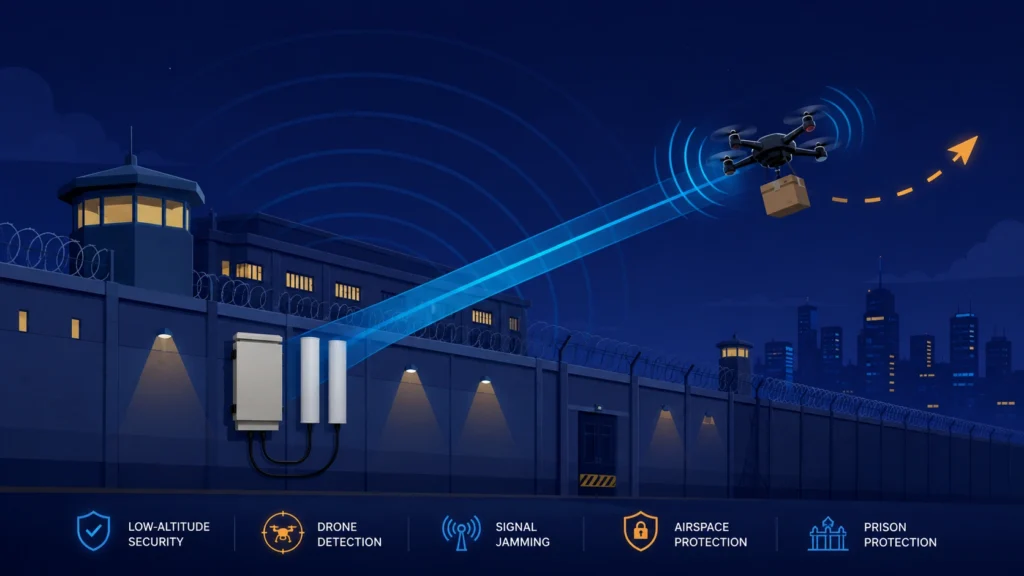
For correctional facilities, Praetorian-CM offers several important advantages.
Fixed Outdoor Deployment
Praetorian-CM is suitable for outdoor fixed installation. It can be installed on walls, poles, building exteriors, or other secure mounting points depending on site conditions. This makes it suitable for prison perimeter areas where long-term deployment is required.
Long-Term Operation
Prison security is not a short-term task. Signal control equipment may need to operate continuously. Praetorian-CM is designed for long-term use, making it more suitable for fixed prison projects than temporary handheld equipment.
Multi-Band Configuration
Drone smuggling prevention and prison signal control may involve different wireless bands depending on the country, operator, and project requirements. Praetorian-CM can be configured according to target frequency bands and project needs.
Power and Coverage Planning
Praetorian-CM supports fixed-site deployment where stronger signal control capability may be required. However, the final configuration should be based on target area, frequency bands, antenna direction, installation height, and environmental conditions. A professional plan should always consider both effective coverage and controlled boundaries.
Remote Control and Multi-Unit Management
Large correctional facilities may require more than one device. Praetorian-CM supports networked management, which is useful for multi-unit deployment. Remote control can help reduce manual inspection and improve daily operation efficiency.
Project Customization
Every prison facility has a different layout. Some facilities have large open yards. Some have dense concrete buildings. Some have high perimeter walls, service roads, or nearby public areas. For this reason, the equipment configuration should be customized according to real site conditions.
Before finalizing a Praetorian-CM project, buyers should confirm:
| Item | What to Confirm |
|---|---|
| Target risk | Drone smuggling, unauthorized phones, or both |
| Frequency bands | Local mobile and wireless bands requiring control |
| Coverage zones | Perimeter wall, yard, exterior building areas, or service roads |
| Installation method | Wall-mounted, pole-mounted, rooftop, or tower installation |
| Installation height | Suitable height to reduce obstruction and manage coverage |
| Power supply | Stable AC power availability at installation points |
| Remote control | Need for networked management and centralized control |
| Multi-unit layout | Number of units and coverage coordination |
| Compliance | Local legal authorization and RF safety requirements |
| Maintenance | Inspection, repair access, and long-term service plan |
In a layered prison security strategy, Praetorian-CM can provide a fixed outdoor signal control layer for selected high-risk areas. It helps correctional facilities move from temporary response toward long-term, managed, and site-specific signal control.
As a source manufacturer of signal jammers and RF modules, Zorelock can support customers with frequency selection, power configuration, installation planning, and multi-unit deployment based on project requirements.
For correctional facilities facing drone smuggling risks, the most effective approach is not to rely on one device alone. The better strategy is to combine physical security, patrol response, detection awareness, intelligence work, legal authorization, and controlled signal management.
Within that framework, Praetorian-CM can be configured as a fixed outdoor signal jammer for long-term prison perimeter security and correctional facility signal control.