

⚠️Important Legal Notice: All content within this article is for educational and informational purposes only. Please be aware that in many jurisdictions, the unauthorized use of equipment designed to jam radio communications (including anti-drone jammers) is strictly illegal and can lead to severe legal penalties. This information does not constitute legal advice. Users bear the sole responsibility for ensuring all actions and technological applications strictly comply with all applicable laws and regulations in their region.
A prison signal jammer is not just a piece of RF equipment placed around a correctional facility. For professional prison security projects, signal jamming should be treated as a long-term RF security engineering task.
Correctional facilities often include multiple functional zones, such as cell blocks, administrative buildings, visitor areas, outdoor yards, perimeter walls, watchtowers, gates, and service roads. These areas create a complex RF environment. Concrete walls, metal structures, building height, terrain, and open outdoor spaces can all affect how jamming signals propagate.
This is why fixed outdoor deployment is often more suitable for prison facilities than temporary or portable jamming equipment. A fixed outdoor prison signal jammer can be installed on walls, poles, towers, or building exteriors to provide more stable and continuous signal control for key areas.
However, effective deployment is not only about output power. A professional project should consider target frequency bands, coverage boundaries, blind spots, antenna direction, installation height, heat dissipation, weather resistance, remote control, and multi-unit coordination.
This article explains the key factors to consider when choosing a prison signal jammer for fixed outdoor deployment, and why Praetorian-CM is suitable for long-term prison security applications.
Fixed Outdoor Deployment for Prison Signal Jamming Projects
Prison signal jamming projects are different from ordinary temporary security tasks. In many cases, the purpose is not short-time signal control, but continuous management of unauthorized wireless communication in sensitive areas.
A fixed outdoor deployment can help prison facilities build a more stable and maintainable signal control system. Instead of moving portable devices from one place to another, fixed units can be installed at selected locations and work as part of the facility’s long-term security infrastructure.
For prison facilities, outdoor deployment has several advantages.
- First, outdoor installation can help cover perimeter areas, yards, open spaces, and building exteriors. These are often important zones in correctional facilities because they may involve movement, supervision, visitor access, service vehicles, and potential unauthorized communication risks.
- Second, fixed outdoor installation makes it easier to plan coverage by area. A prison facility may need signal control around specific zones rather than across the entire site without distinction. By placing fixed devices on walls, poles, or building exteriors, project teams can plan the jamming area more systematically.
- Third, fixed deployment supports long-term operation and maintenance. Once the installation points, power supply, network connection, and equipment configuration are confirmed, the system can be managed more efficiently than temporary devices.
However, fixed outdoor deployment also requires careful planning. A prison is not an open field. Signal propagation may be affected by thick walls, reinforced concrete, metal fences, building corners, watchtowers, trees, slopes, and surrounding base station signal strength. These factors may create uneven coverage or blind spots if the project is planned only by estimating distance.
Therefore, the first step in a prison signal jammer project should not be asking “How powerful is the jammer?” The better starting point is:
- Which areas need signal control?
- Which frequency bands need to be managed?
- Where can the device be installed safely?
- What height is suitable for coverage?
- Will multiple units be needed?
- How will the system be powered and controlled?
- How can long-term maintenance be simplified?
A professional fixed outdoor deployment should balance security needs, RF performance, installation conditions, and operational management.
Key Factors for Prison Signal Jammer Selection
When choosing a prison signal jammer, buyers should avoid evaluating the product only by output power. Power matters, but it is only one part of the complete system.
- Target frequency band. Different countries and operators may use different mobile communication bands. Before choosing a jammer, the project team should confirm which bands need to be controlled at the site. A prison signal jammer should support the required bands and allow configuration according to the actual project. Here we provide you with the website entrance for Frequency Check, making it convenient for you to refer to the communication frequencies used in various countries. For reference only.
| Target Region | Common Mobile Communication Bands | Typical Use | Notes for Prison Signal Jammer Projects |
|---|---|---|---|
| Asia-Pacific | 700MHz, 850MHz, 900MHz, 1800MHz, 2100MHz, 2300MHz, 2600MHz, 3300–3800MHz | 2G/3G/4G LTE/5G NR | Frequency use varies greatly by country. 700MHz, 1800MHz, 2100MHz, 2300MHz, 2600MHz, and 3.5GHz bands are commonly seen in many APAC mobile networks. |
| North America | 600MHz, 700MHz, 850MHz, AWS 1700/2100MHz, PCS 1900MHz, 2300MHz, 2500MHz, 3450–3980MHz, 28GHz, 39GHz | 4G LTE/5G NR | North America uses several region-specific bands, including 600MHz, AWS, PCS, CBRS, C-band, 2.5GHz, and mmWave bands. Final configuration should be checked by country and operator. |
| Europe | 700MHz, 800MHz, 900MHz, 1800MHz, 2100MHz, 2300MHz, 2600MHz, 3400–3800MHz | 2G/3G/4G LTE/5G NR | European mobile networks commonly use 700MHz, 800MHz, 900MHz, 1800MHz, 2100MHz, 2600MHz, and 3.4–3.8GHz bands. Some countries may also use 2300MHz or other additional bands. |
| Middle East | 700MHz, 800MHz, 900MHz, 1800MHz, 2100MHz, 2300MHz, 2600MHz, 3300–3800MHz | 2G/3G/4G LTE/5G NR | GCC markets have been active in 5G deployment, especially in mid-band spectrum. 1800MHz, 2100MHz, 2600MHz, and 3.5GHz are important bands in many Middle East markets. |
| South America | 700MHz, 850MHz, AWS 1700/2100MHz, 1800MHz, PCS 1900MHz, 2100MHz, 2600MHz, 3300–3800MHz | 2G/3G/4G LTE/5G NR | Latin American markets commonly use 700MHz, 850MHz, AWS, 1900MHz, 2100MHz, and 2600MHz. 3.5GHz is increasingly important for 5G deployment. |
| Africa | 700MHz, 800MHz, 850MHz, 900MHz, 1800MHz, 2100MHz, 2300MHz, 2600MHz, 3300–3800MHz | 2G/3G/4G LTE/5G NR | 900MHz, 1800MHz, and 2100MHz remain important in many African markets. 700MHz, 800MHz, 2600MHz, and 3.5GHz are increasingly relevant for mobile broadband and 5G planning. |
Mainstream communication frequencies in major regions of the world
- Jamming power. Higher power can support larger coverage potential, but it also increases heat, power consumption, installation requirements, and system cost. For fixed prison deployment, stable and controllable output is usually more important than simply choosing the highest possible wattage.
- Coverage performance. Coverage depends on the combination of frequency, power, antenna design, installation height, environment, and local signal strength. Two devices with similar power may perform differently if they use different antennas, are installed at different heights, or face different building obstructions.
- Antenna configuration. Antennas affect signal direction, coverage shape, and jamming efficiency. In some prison projects, omnidirectional coverage may be useful for open areas. In other cases, directional coverage may be preferred to focus the signal toward selected zones and reduce unnecessary signal leakage outside the target area.
- Installation condition. A fixed outdoor device needs suitable mounting points, stable power supply, safe cable routing, protection from unauthorized access, and enough space for heat dissipation. A good product should not only meet RF specifications, but also be practical for real site installation.
- Maintenance and control. Prison facilities usually require long-term operation. If every device must be checked manually, maintenance becomes time-consuming. Network communication, remote control, and centralized management can help reduce operational workload.
In short, choosing a prison signal jammer should be based on the whole deployment environment. Frequency bands, power, coverage, antenna, installation, cooling, remote control, and maintenance should be considered together.
Outdoor Deployment: Height, Mounting, and Environment
Outdoor deployment is one of the most important parts of a prison signal jammer project.
A fixed outdoor jammer may be installed on perimeter walls, poles, building exteriors, rooftops, watchtowers, or other secure mounting points. The exact position should be selected according to the facility layout, target area, surrounding obstacles, and available power or network connections.
- Installation height has a direct impact on coverage. If the jammer is installed too low, buildings, walls, vehicles, trees, or metal structures may block part of the signal. If it is installed too high, coverage direction and signal leakage must be considered carefully. A suitable height can help reduce obstruction and improve the effective coverage of the target area.
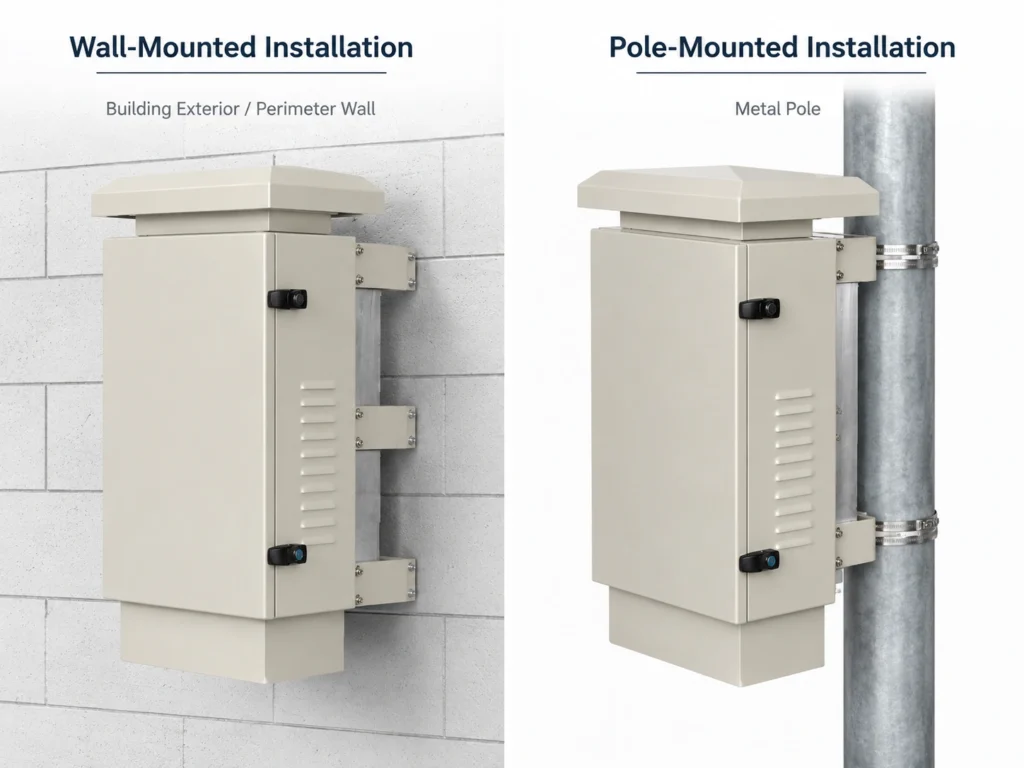
- Mounting method is also important. Wall-mounted installation is suitable when the device needs to be fixed to a building exterior, perimeter wall, or other vertical structure. Pole-mounted installation is useful when the project requires more flexible positioning or better height adjustment. For prison facilities, both methods may be used depending on site conditions.
- Environmental durability should not be ignored. Outdoor equipment may face rain, dust, heat, low temperature, wind, sunlight, and long-term exposure. A device designed only for indoor or temporary use may not be suitable for continuous outdoor prison deployment.
A reliable outdoor prison signal jammer should consider:
- Rainproof structure
- Stable casing material
- Heat dissipation design
- Cable and connector protection
- Secure mounting structure
- High and low temperature tolerance
- Long-term outdoor reliability
The surrounding environment also affects RF performance. Thick concrete buildings, metal bars, reinforced walls, and complex internal structures can change the actual jamming effect. This is why the final installation plan should be based on the facility layout and, when possible, a site signal survey.
This article focuses on fixed outdoor deployment factors. More detailed coverage planning, such as how to divide prison zones, estimate device quantity, avoid blind spots, and control signal leakage, can be discussed in a separate coverage planning guide.
24/7 Operation, Remote Control, and Multi-Unit Management
Prison signal control is usually not a short-term task. In many correctional facilities, equipment may need to operate continuously for long periods. This makes 24/7 reliability one of the most important requirements for fixed outdoor deployment.
Continuous operation creates higher requirements for cooling, power stability, component reliability, and structural design. If heat is not controlled properly, the jammer may experience power drop, unstable output, shorter component lifespan, or higher failure risk.
For high-power outdoor equipment, thermal design is especially important. A stable heat dissipation structure helps the device maintain continuous output and reduces maintenance problems. This is one reason why fixed prison jammers should be selected differently from small portable jammers.
Remote control is another key factor. In a large correctional facility, equipment may be installed in different outdoor locations. If staff need to physically access each device for every inspection or adjustment, maintenance becomes inefficient and may increase operational risk.
A network communication interface can help facility managers monitor and control devices more conveniently. For example, RJ45 communication can support networked deployment and centralized management. This is useful when multiple devices are installed around a prison facility.
Multi-unit management is often necessary because one jammer may not cover every important area. A large prison may include multiple buildings, open yards, perimeter walls, and service areas. Different zones may require different installation points or power configurations.
When multiple units are used, the project should consider:
- Device location
- Coverage overlap
- Frequency configuration
- Power distribution
- Remote control method
- Maintenance access
- Network connection
- System expansion
The goal is not only to install several devices, but to create a manageable and stable signal control system. For long-term prison security, centralized control and maintenance efficiency can be as important as RF output power.
Praetorian-CM for Prison Fixed Outdoor Deployment
Praetorian-CM is designed as a stationary signal jammer for prison and correctional facility applications. It is suitable for fixed outdoor deployment where long-term operation, environmental durability, multi-band jamming, and remote management are important.
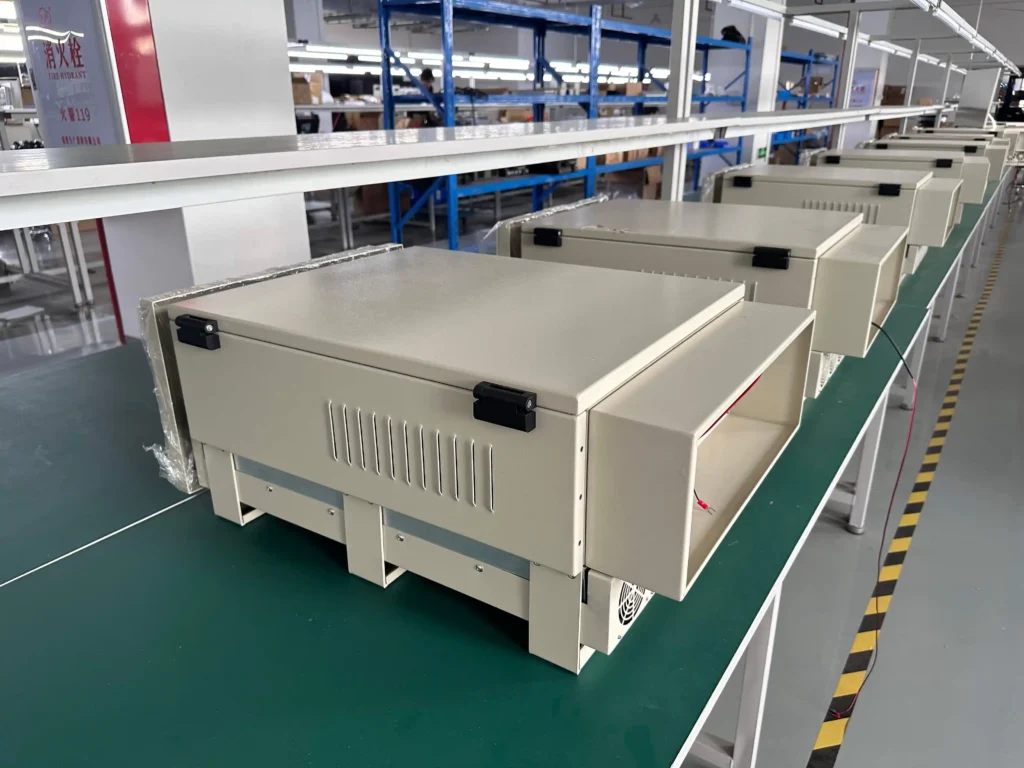
For prison projects, Praetorian-CM offers several advantages.
- First, it is designed for outdoor and harsh operating conditions. This makes it more suitable for perimeter walls, poles, building exteriors, and other fixed outdoor locations than temporary or handheld equipment.
- Second, it supports continuous 24/7 operation. In prison security projects, signal control often needs to run continuously rather than only during temporary events. A device with efficient thermal design and long-term operating capability is important for this type of application.
- Third, Praetorian-CM supports multi-band jamming. Prison facilities may need to control different wireless bands depending on the local communication environment and project requirements. The channels and power can be customized according to specific needs.
- Fourth, Praetorian-CM supports 50W–100W jamming power options. This range is suitable for fixed-site projects that need stronger output than portable devices while still requiring stable operation and manageable installation.
- Fifth, it supports wall-mounted and pole-mounted installation. This allows project teams to install the device according to the prison layout, coverage direction, mounting conditions, and available infrastructure.
- Sixth, it supports RJ45 communication, making it suitable for networked deployment and centralized management. For prison facilities with multiple units, remote control and system management can help reduce manual inspection and improve maintenance efficiency.
Praetorian-CM is also suitable for projects where multiple devices are used together to provide wide-area coverage. Networked units can help form a more complete signal control solution for complex prison environments.
Before selecting the final configuration, buyers should confirm the following information:
| Item | What to Confirm |
|---|---|
| Target bands | Which mobile or wireless bands need to be controlled? |
| Coverage area | Which prison zones require signal control? |
| Installation points | Wall-mounted, pole-mounted, rooftop, or tower installation? |
| Installation height | What height can reduce obstruction and improve coverage? |
| Power supply | Is stable AC power available at each point? |
| Network control | Is RJ45 or centralized management required? |
| Outdoor environment | Rain, dust, temperature, wind, and sun exposure |
| Multi-unit planning | How many devices are needed for the target area? |
| Maintenance | How will inspection and service be handled? |
| Compliance | Is the project authorized under local regulations? |
A prison signal jammer project should not be treated as a simple product purchase. It should be planned as a fixed outdoor RF security deployment. The most suitable solution depends on the facility layout, target frequency bands, installation conditions, coverage requirements, and long-term operation plan.
As a source manufacturer of signal jammers and RF modules, Zorelock can help customers evaluate frequency bands, installation methods, power configuration, and multi-unit deployment based on the facility layout and project requirements.
If you are planning a prison signal jammer project, Praetorian-CM can be configured for fixed outdoor deployment in correctional facilities, prisons, and other high-security sites requiring long-term signal control.