

⚠️Important Legal Notice: All content within this article is for educational and informational purposes only. Please be aware that in many jurisdictions, the unauthorized use of equipment designed to jam radio communications (including anti-drone jammers) is strictly illegal and can lead to severe legal penalties. This information does not constitute legal advice. Users bear the sole responsibility for ensuring all actions and technological applications strictly comply with all applicable laws and regulations in their region.
1. Guarulhos Airport and the New Drone Security Challenge
Airport drone defense is moving from occasional incident response toward structured, system-level protection. A recent example comes from Brazil. On September 11, 2026, the Ministry of Ports and Airports announced specific guidelines for implementing an anti-drone system at São Paulo/Guarulhos International Airport. The planned capabilities include drone detection, monitoring, mitigation, and neutralization, while the airport operator will be responsible for procurement, deployment, operation, first response, and communication with authorities.
Guarulhos was selected because of its importance to Brazil’s aviation network and its history of drone occurrences near the airport. The Brazilian government also stated that the experience may help determine whether similar systems should be adopted at other airports. Importantly, DECEA will participate in defining protected areas and the procedures for suspending and resuming air operations.
That point reveals a key reality: counter-drone operations can affect normal airport operations if they are not carefully coordinated. Unauthorized drones themselves may cause delays, runway restrictions, or temporary operational changes. Counter-drone systems can also introduce risks if they interfere with legitimate communications, navigation, radar, or air traffic management systems.
For airport operators, the goal is therefore not simply to detect or jam a drone. It is to manage the threat while minimizing disruption to normal flights. That requires a coordinated workflow connecting detection, identification, operational decision-making, countermeasures, and recovery.
2. From Detection to Coordinated Response
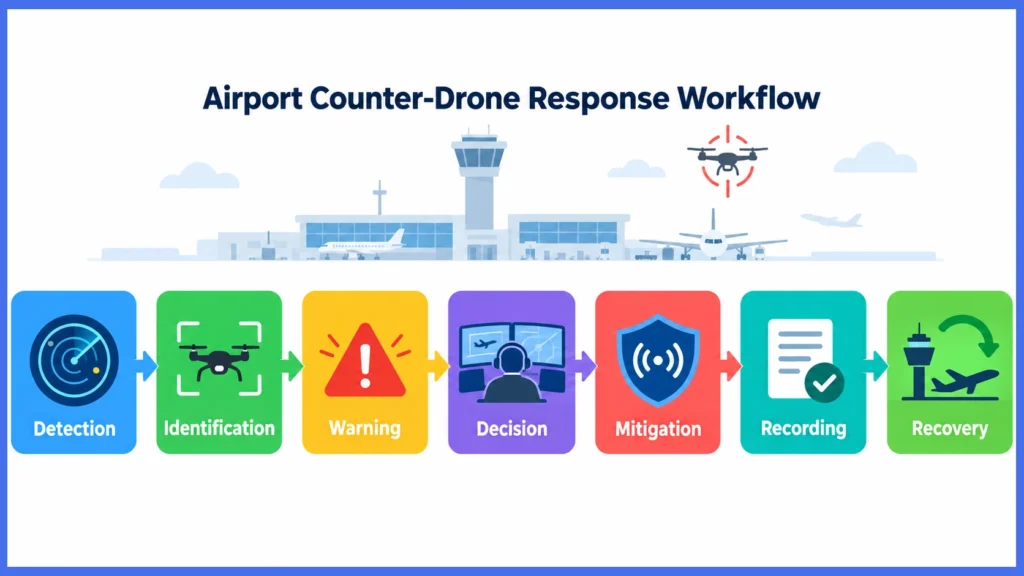
Detection is the beginning of airport drone defense, not the end. A professional counter-drone system should support a response chain in which information moves quickly from sensors to operators and, when legally authorized, to the countermeasure layer.
The process starts with detection. The system needs to discover suspicious low-altitude activity and provide useful information such as direction, location, or flight path.
Identification comes next. Operators need to determine what the target is, whether it is authorized, and whether its behavior creates a security risk.
Once a target is confirmed, the system should issue a clear warning. Security personnel need enough information to assess the drone’s position, route, proximity to protected areas, and threat level.
The decision stage is especially important at airports. Not every detected drone should automatically trigger jamming. The response must consider the target location, authorization status, nearby aircraft, airport operating conditions, local regulations, and possible effects on surrounding systems.
If mitigation is authorized, jamming or another approved countermeasure may be applied in a controlled manner. The objective should be precise and limited response—not maximum RF output.
Finally, the event should be recorded. Flight tracks, alerts, operator decisions, countermeasure actions, and the return to normal operations can support later review and system tuning.
The workflow can be summarized as:
Detection → Identification → Warning → Decision → Mitigation → Recording → Recovery
For a more detailed explanation of how detection and jamming complement each other, read our Drone Detector vs Drone Jammer: How They Work Together in an Anti-Drone System.
FAA guidance notes that operational use of UAS detection and mitigation systems may trigger response actions that disrupt air traffic operations or create safety and efficiency impacts. These effects should be addressed through risk-based procedures coordinated with airport and air traffic authorities.
3. Key Factors in Airport Anti-Drone Deployment
Airport anti-drone deployment is an engineering and operational problem, not simply a product selection problem.
Coverage comes first. Airports contain different security zones, including runway surroundings, aprons, terminals, perimeter roads, open land, and access points. These areas do not all require the same sensor position or countermeasure direction, and one device should not automatically be assumed to cover an entire airport.
The RF environment is another critical factor. Different drones may use different control, video transmission, or navigation-related frequencies, while airports depend on legitimate radio, radar, navigation, and air traffic management systems.
ICAO guidance states that counter-UAS technology should not interfere with frequencies used by aircraft, air traffic management systems, or other authorized applications, and should not interfere with daily aerodrome and airspace operations.
This is why interference boundaries matter. In airport applications, the key question is not:
How much jamming power can the system produce?
It is:
How precisely can the response area be controlled?
Antenna direction, output power, installation position, operating frequencies, and coverage boundaries should all be evaluated together.
Large airports may also require multi-unit coordination. The FAA also notes that UAS detection and mitigation technologies may introduce electromagnetic interference or operational effects, which is why airport deployment requires risk-based coordination with aviation authorities. Multiple detectors or countermeasure units may operate at different locations, making network communication, overlapping coverage, centralized control, remote monitoring, and maintenance planning important.
Finally, there is legal and operational authorization. At Guarulhos, implementation is coordinated among ANAC, the Federal Police, DECEA, Receita Federal, and Anatel, and the equipment used must be homologated by Anatel.
This shows that airport counter-drone deployment involves aviation safety, spectrum regulation, law enforcement, and airport operations at the same time.
For airport environments, precision, coordination, and controllability are often more important than simply increasing RF output power.
4. Integrated Airport Drone Defense with Pine-INT-CH5
As airport drone risks become more complex, integrated systems can reduce the gap between detection and response. Instead of treating the detector, jammer, and control process as separate elements, an integrated architecture can connect situational awareness with authorized countermeasure capability.
Zorelock’s Pine-INT-CH5 is designed as an integrated detecting and jamming anti-drone system. It combines detection with a four-sided directional jamming architecture and supports detection, identification, jamming, and coordinated countermeasure functions. It can be used in fixed or vehicle-mounted deployments and supports automated detection and defense strategy configuration.
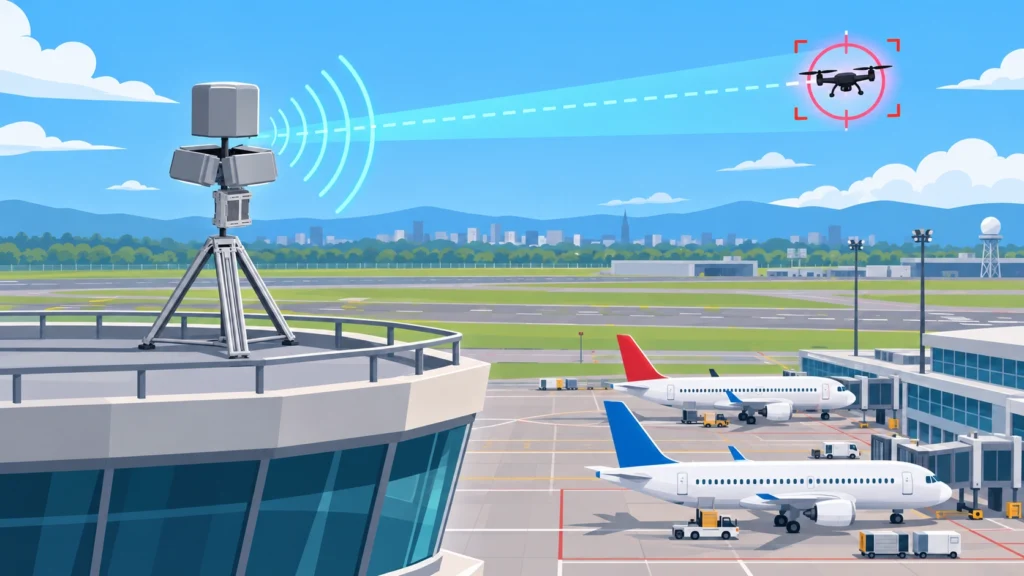
For airport projects, however, the value of this architecture should not be measured only by detection range or RF power. A more important consideration is whether the system can support a controlled response without creating unnecessary effects on normal airport operations.
Directional jamming, configurable frequency bands, centralized management, and the ability to connect detection with countermeasure decisions can help project teams design more precise protection zones. But final system configuration must still be based on site layout, local spectrum conditions, protected areas, nearby aviation systems, and legal authorization.
FAA and ICAO guidance both emphasize that counter-drone systems should be evaluated for unintended effects on aviation operations and communication or navigation systems. FAA also notes that C-UAS deployment may affect ATC or air-navigation systems through RF interference and therefore requires coordination.
Therefore, the preferred airport deployment strategy is not continuous, unrestricted jamming. It is:
early detection + reliable identification + informed decision-making + controlled countermeasure
The Guarulhos case reflects this broader direction: airport drone defense is becoming a coordinated operational process rather than a standalone security device.
For airport projects, the central question is not which system has the highest advertised power. It is whether the complete architecture can detect early, support fast decisions, protect normal flight operations, and deliver a precise response when required.