

⚠️Important Legal Notice: All content within this article is for educational and informational purposes only. Please be aware that in many jurisdictions, the unauthorized use of equipment designed to jam radio communications (including anti-drone jammers) is strictly illegal and can lead to severe legal penalties. This information does not constitute legal advice. Users bear the sole responsibility for ensuring all actions and technological applications strictly comply with all applicable laws and regulations in their region.
Choosing the right RF power amplifier module is one of the most important steps when designing or purchasing a signal jammer.
A signal jammer does not rely only on antennas, battery capacity, or external appearance. Its real performance depends heavily on the RF module inside the device. The module affects output power, frequency coverage, bandwidth, heat dissipation, antenna matching, control method, working stability, product size, and final cost.
For many buyers, RF module selection can be confusing. Some compare only wattage. Some only ask whether the frequency range can be covered. Others choose a very wide bandwidth without considering average power, heat dissipation, or the final jammer structure.
This guide explains how to choose RF power amplifier modules for signal jammers, using Zorelock’s real RF module and signal jammer product examples.
Why the RF Power Amplifier Module Matters
The RF power amplifier module is one of the core components inside a signal jammer. It receives the RF signal from the signal source, amplifies it, and sends it to the antenna. The antenna then radiates the amplified signal into the target frequency band.
A typical RF power amplifier module may include:
- Signal source, such as VCO or DDS
- RF amplifier circuit
- LDMOS or GaN transistor
- RF output connector
- DC power supply interface
- Enable switch
- Temperature or power monitoring circuit
- VSWR protection
- Aluminum housing for protection and heat dissipation
For a signal jammer manufacturer, the module is not just a replaceable part. It affects the complete product design, including enclosure structure, cooling airflow, antenna layout, battery system, control board, maintenance method, and long-term reliability.
That is why selecting the right RF module should always start from the final jammer application, not only from the module datasheet.
Understand Module Naming and Signal Source Types
Before comparing specifications, it is useful to understand Zorelock’s RF module naming rule.
For example:
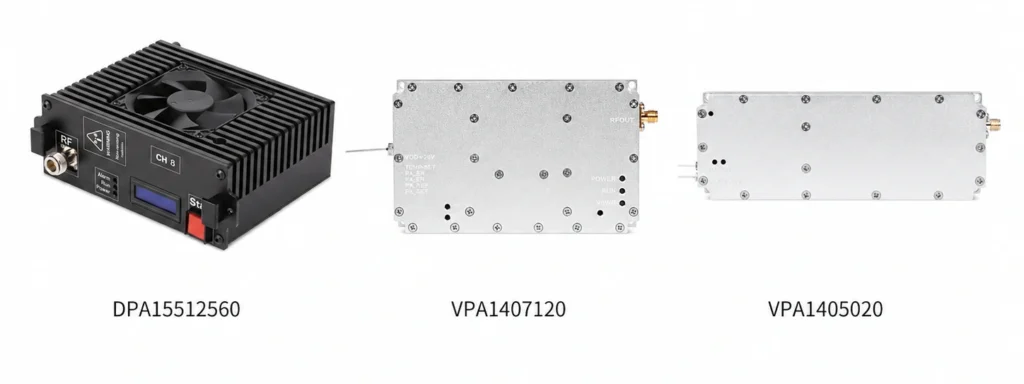
The naming rule is simple:
- D = DDS signal source
- V = VCO signal source
- PA = Power Amplifier
- The following numbers represent the module size
For example, DPA15512560 means:
- DDS signal source
- Power amplifier module
- Size: 155 × 125 × 60 mm
VPA1405020 means:
- VCO signal source
- Power amplifier module
- Size: 140 × 50 × 20 mm
There are two common signal source types in RF power amplifier modules: VCO and DDS.
A VCO module uses a voltage-controlled oscillator as the signal source. It is commonly used in standard jammer designs because it is compact, practical, and cost-effective. VCO modules are suitable for portable jammers, standard anti-drone jammers, multi-band jammer devices, and projects with clear frequency requirements.
A DDS module provides stronger software-defined control capability. It is more suitable for projects that require flexible frequency control, digital communication, or sub-band configuration.
For example, Zorelock’s DPA15512560 supports RS485 communication, 7W2 connector, N-F RF output connector, and 50W/100W standard RF output power options. It can divide up to four independent sub-bands within its gain bandwidth through software algorithms.
In simple terms, VCO modules are suitable for many standard jammer designs, while DDS modules are better for advanced systems requiring more flexible control.
Start from the Final Signal Jammer Type
A common mistake is to choose an RF module first and then design the signal jammer around it.
A better method is to start from the final jammer type. A handheld jammer gun, trolley-case jammer, and stationary jammer have very different requirements for RF modules.

| Jammer Type | Zorelock Product Example | Product Features | RF Module Selection Focus |
|---|---|---|---|
| Portable jammer gun | Lance-CM | 30W–50W power, built-in 28V battery, 60° directional coverage | Compact size, low heat, battery compatibility, stable directional output |
| Portable trolley-case jammer | Chariot-CM | 50W–100W power, internal 28V lithium battery, 360° horizontal jamming | Multi-channel consistency, heat dissipation, power supply capacity |
| Stationary signal jammer | Praetorian-CM | 50W–100W power, AC 210V–240V, RJ45, wall or pole installation | Long-term stability, monitoring interface, VSWR protection, cooling design |
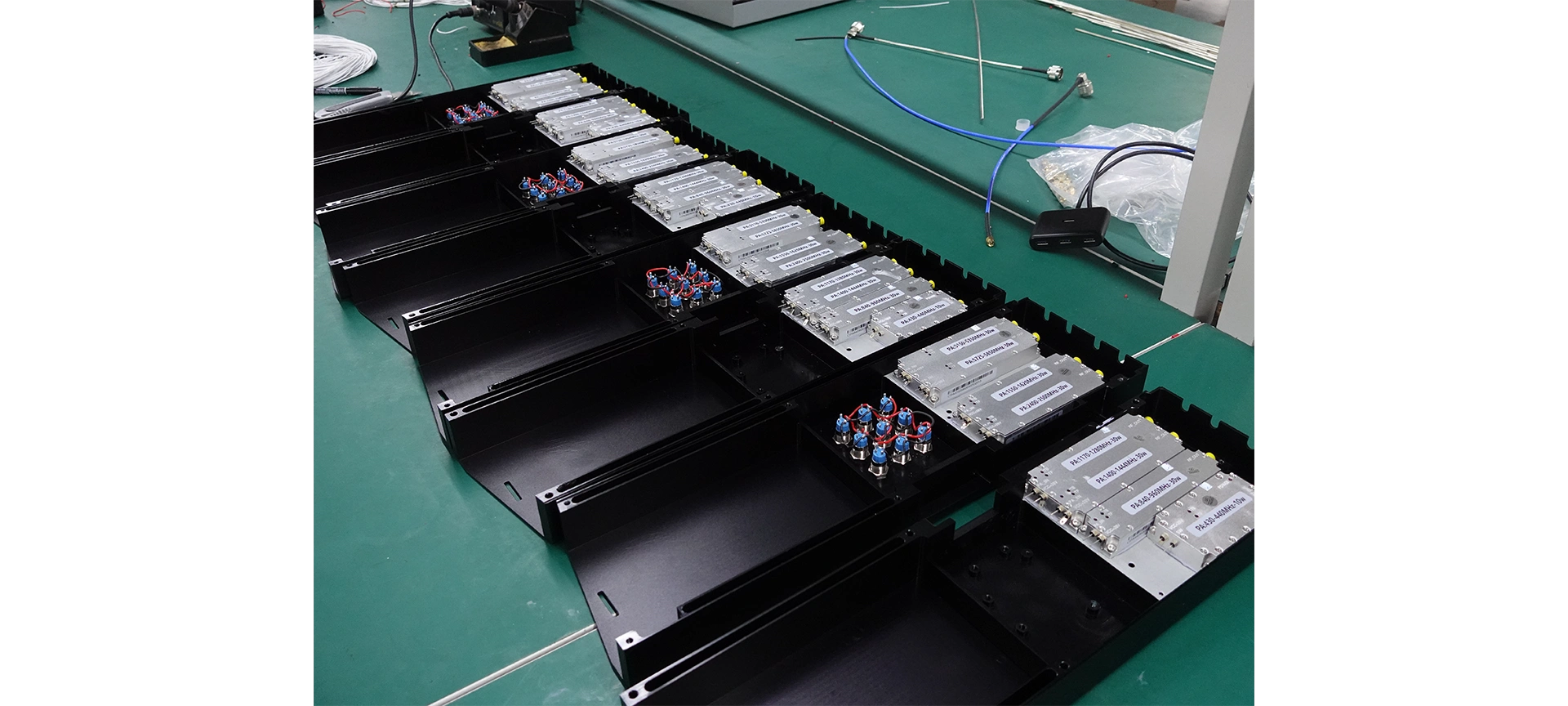
For a portable jammer gun such as Lance-CM, the RF module should be compact, efficient, and suitable for battery-powered operation. Heat and current consumption are very important because the device needs to remain portable.
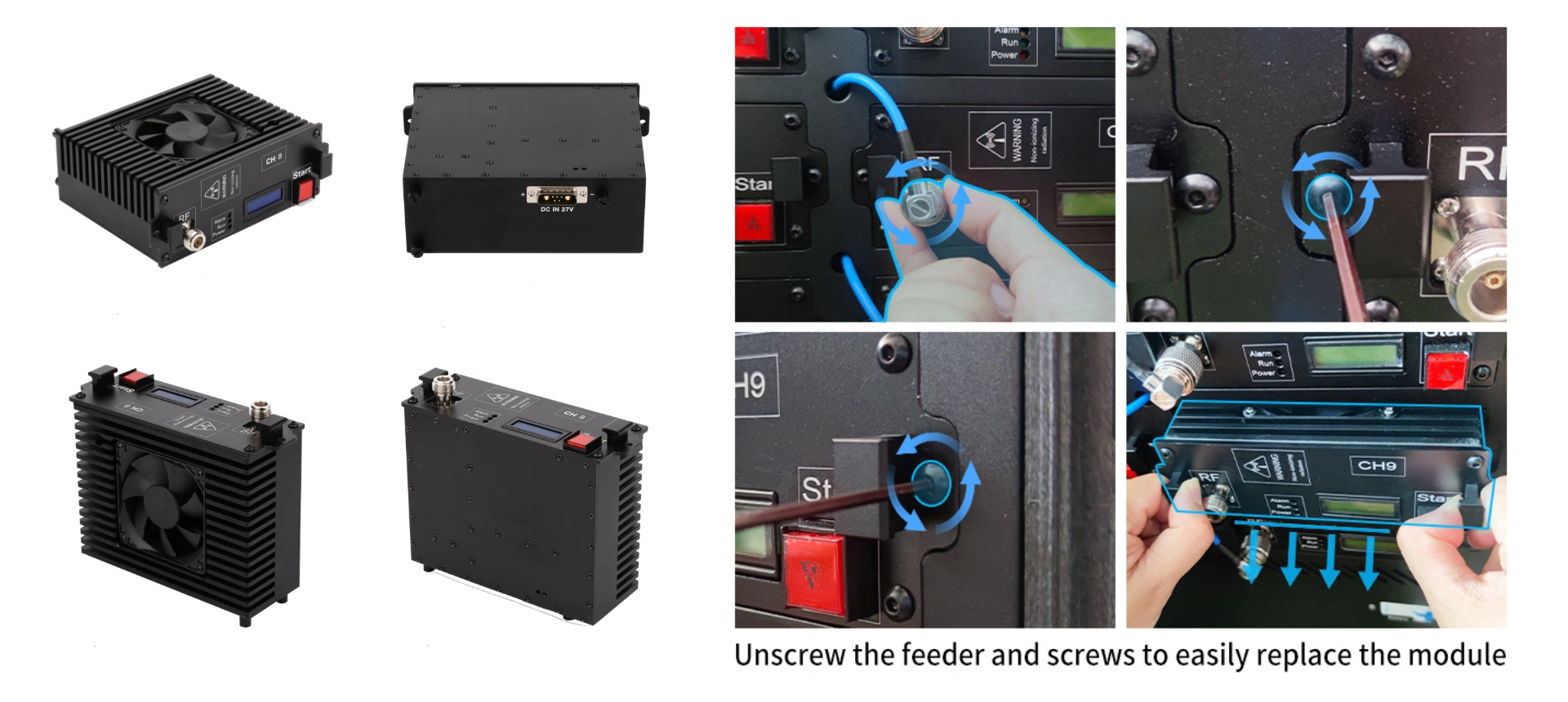
For a trolley-case jammer such as Chariot-CM, the product has more internal space than a handheld jammer, but it still requires portable deployment. Multi-channel consistency, power supply capacity, and airflow design become more important.
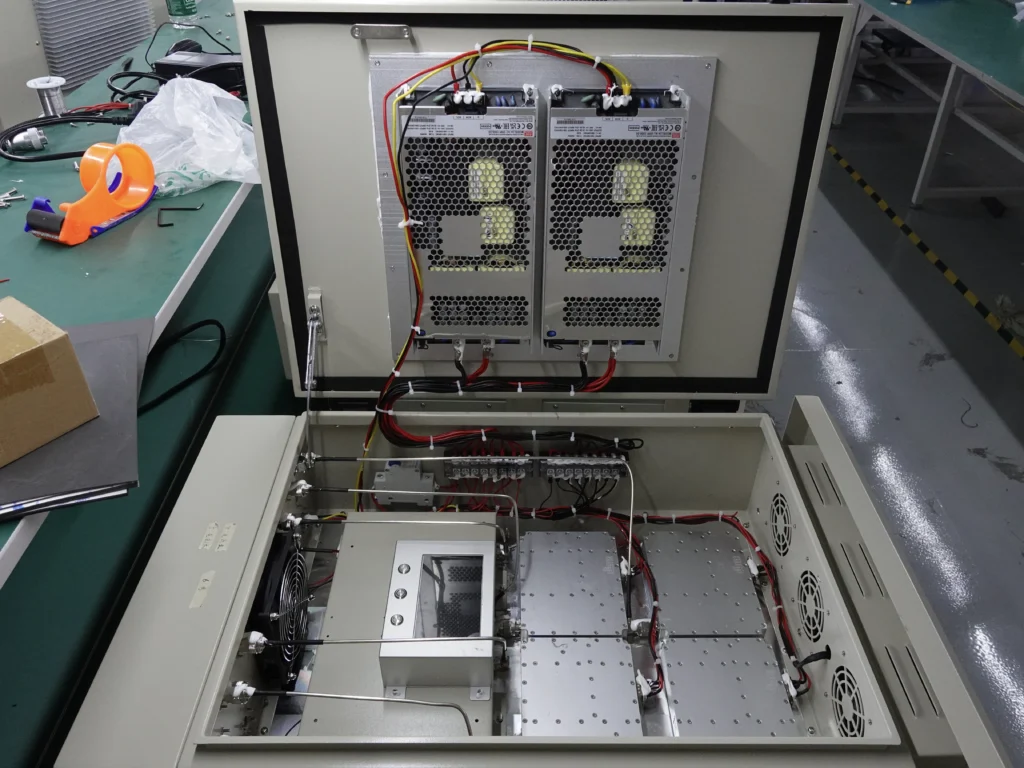
For a stationary jammer such as Praetorian-CM, compact size is less important than long-term stability. The RF module should support stronger heat dissipation, monitoring interface, VSWR protection, and reliable operation in outdoor or fixed-site environments.
The best RF power amplifier module is not always the smallest one, the cheapest one, or the highest-power one. The correct module depends on the final jammer design.
Confirm Frequency Range, Bandwidth, and Output Power
Frequency range is one of the first technical specifications to confirm.
A common mistake is to choose the widest possible frequency range. In signal jammer design, wider is not always better.
The reason is simple: when the same output power is spread across a wider bandwidth, the average power in each MHz becomes lower.
A practical formula is:
Average Power = Total Power / Bandwidth
For example:
| Module Design | Total Power | Frequency Range | Bandwidth | Average Power |
|---|---|---|---|---|
| Narrow-band design | 100W | 2400–2500MHz | 100MHz | 1W/MHz |
| Wide-band design | 100W | 2000–2700MHz | 700MHz | 0.14W/MHz |
Both designs may be marked as 100W, but their real performance can be very different.
So when selecting a module, do not only ask:
“Can this module cover my target frequency?”
You should also ask:
“What is the actual output bandwidth, and how much power is distributed across that band?”
Output power is important, but wattage alone does not fully determine signal jammer performance. A 100W module is not always better than a 50W module. The real effect depends on frequency range, bandwidth, average power, in-band fluctuation, gain flatness, heat dissipation, antenna matching, power supply stability, and working environment.
For example, a 50W module with a narrow and accurate frequency band may perform better than a 100W module with an overly wide and inefficient frequency range.
For more details about power, frequency, antenna, and environment, you can read:
How Far Can a Signal Jammer Work?
Compare Zorelock RF Module Examples
Zorelock offers different RF power amplifier modules for different jammer designs. The following examples show how module specifications should match the final product requirements.
| Module | Signal Source | Key Feature | Suitable Product Direction |
|---|---|---|---|
| DPA15512560 | DDS | 50W/100W output options, RS485, 7W2 connector, N-F RF output, software-defined sub-band control | Advanced anti-drone jammer or software-controlled system |
| VPA1405020 | VCO | 50W GaN module, 28V operating voltage, 5V enable switch, ±1dB in-band fluctuation, over-temperature and standing wave protection | Compact portable or standard anti-drone jammer |
| VPA1407120 | VCO | 50W/100W options, XH2.54 monitoring interface, temperature detection, forward power detection, VSWR alarm | Fixed signal jammer requiring monitoring and protection |
DPA15512560 is more suitable for projects requiring DDS control, RS485 communication, and flexible sub-band configuration.
VPA1405020 is suitable for compact 50W VCO GaN jammer designs where size, efficiency, and stable output are important.
VPA1407120 is more suitable for fixed signal jammers because it supports monitoring functions, VSWR protection, and long-term maintenance needs.
This comparison also shows why module selection should not be based on output power alone. Signal source type, interface, protection function, and installation environment all matter.
Check Power Supply, Heat Dissipation, and Antenna Matching
Most high-power RF power amplifier modules require a stable DC power supply.
Many Zorelock RF modules use 28V DC operating voltage. This is especially important for battery-powered signal jammers. As a lithium battery discharges, the voltage may drop. When the voltage drops, the RF module may no longer maintain full output power, which reduces the actual jamming range.
Before choosing a module, buyers should confirm:
- Operating voltage
- Maximum current
- Battery compatibility
- Power cable design
- Connector type
- Continuous working time
- Voltage stability
- Power supply margin
Heat dissipation is another key factor. RF power amplifier modules generate heat during operation. Poor heat management may cause output power drop, unstable performance, shorter component lifespan, module shutdown, or even damage to transistors and PCB components.
When selecting a module, check module size, module weight, housing structure, heat sink contact surface, fan or airflow requirement, operating temperature range, over-temperature protection, and installation space inside the enclosure.
RF module selection should also match the antenna design. Omnidirectional antennas cover 360° horizontally and are suitable for area coverage. Directional antennas focus the signal in one direction and can provide longer directional range at the cost of reduced coverage in other directions.
This is why Lance-CM, Chariot-CM, and Praetorian-CM require different module and antenna strategies. Lance-CM uses directional coverage, so the RF module should support concentrated output and stable performance under battery power. Chariot-CM provides 360° horizontal jamming, so multi-channel consistency and omnidirectional antenna matching become more important. Praetorian-CM is designed for fixed outdoor deployment, so the RF module should support long-term output stability and easier maintenance.
Evaluate Connectors, Control, Monitoring, and Protection
The RF connector affects power handling, antenna matching, installation, and long-term reliability.
Common connector and interface options may include:
- SMA-F
- N-F
- 7W2
- XH2.54
- Customized power or control interface
In many RF module designs, SMA connectors are often used for compact or medium-power modules, while N-type connectors are more suitable for higher-power output.
Before selecting a module, confirm the RF output connector type, antenna connector compatibility, cable direction, installation space, mechanical strength, maintenance convenience, and power supply interface.
Control and monitoring functions should also be considered. For simple portable jammers, a basic enable switch may be enough. For fixed signal jammers or advanced systems, monitoring functions are very useful because they allow users to check module status without opening the enclosure frequently.
Signal jammers may face antenna mismatch, loose connectors, incorrect antenna frequency, damaged cables, or high reflected power. These problems may create high VSWR and reflected power. Without proper protection, the RF module may be damaged.
Important protection functions include over-temperature protection, standing wave protection, VSWR alarm, forward power detection, reverse power detection, and LED alarm indicators.
For high-power and long-term operating signal jammers, monitoring and protection functions should not be ignored.
Pay Attention to PCB, Transistor Technology, and Factory Testing
The transistor is the core component of the RF power amplifier circuit. The entire RF PCB design is usually built around the transistor.
High-frequency RF circuits require good impedance control, low signal loss, stable grounding, and reliable thermal performance. This is why RF amplifier modules should not be evaluated only by appearance or price.
For transistor technology, LDMOS has been widely used in many RF amplifier products. GaN technology is becoming increasingly popular because it can offer higher efficiency, lower current, and better heat performance in suitable designs.
GaN modules are especially useful when the jammer requires:
- Compact structure
- Higher efficiency
- Lower heat generation
- Stable output
- Better power density
- Battery-powered operation
Factory testing is equally important. A reliable RF power amplifier module should be tested before shipment.
Professional testing should include:
- Frequency range verification
- Output power testing
- Spectrum inspection
- Self-excitation checking
- Spurious emission checking
- Temperature-related testing
- Burn-in testing
- Final QC inspection
Zorelock’s RF amplifier module production process includes specification confirmation, SMT assembly, RF testing, aging test, QC inspection, labeling, and packaging.
Testing is important because two modules may look similar from the outside, but their real performance can be very different.
For more details, read:
RF Amplifier Module Manufacturing: From Order to Delivery
RF Power Amplifier Module Selection Checklist
Before placing an order, confirm the following information:
| Item | Question to Confirm |
|---|---|
| Signal source | Do you need VCO or DDS? |
| Frequency | What exact frequency range should the module cover? |
| Bandwidth | Is the selected bandwidth too wide for the target signal? |
| Output power | Do you need 50W, 100W, or another power level? |
| Jammer type | Portable gun, trolley-case jammer, fixed jammer, or customized system? |
| Size | Can the module fit inside the jammer housing? |
| Weight | Is the module suitable for portable use? |
| Voltage | Is your power system compatible with the module? |
| Current | Can the power supply support continuous operation? |
| Connector | SMA-F, N-F, 7W2, XH2.54, or customized interface? |
| Control | Do you need a 5V enable switch? |
| Monitoring | Do you need temperature, power, or VSWR status? |
| Cooling | Is there enough heat dissipation space? |
| Protection | Does the module support VSWR and over-temperature protection? |
| Testing | Has the module passed RF testing and aging test? |
Choosing RF power amplifier modules for signal jammers is not simply about selecting the highest output power.
A suitable RF module must match the complete jammer design, including signal source type, frequency range, bandwidth, output power, antenna type, power supply, cooling structure, connector layout, control method, monitoring requirement, protection function, and operating environment.
For portable jammer guns such as Lance-CM, compact size, battery compatibility, directional antenna matching, and heat control are important.
For trolley-case jammers such as Chariot-CM, multi-channel integration, 360° coverage, airflow design, and power supply capacity become more critical.
For stationary signal jammers such as Praetorian-CM, long-term stability, monitoring interface, VSWR protection, and outdoor thermal design should be prioritized.
As a source manufacturer of signal jammers and RF modules, Zorelock can support both RF module selection and complete jammer customization. Whether you are developing a portable jammer, trolley-case jammer, stationary jammer, or customized anti-drone system, our engineering team can help confirm the right frequency, output power, bandwidth, interface, cooling method, and module configuration before production.